Your creative capital is under siege. Every upload to a cloud server is a surrender of your intellectual property. If you aren't using a privacy first video editor, you're effectively donating your professional edge to a data broker's training set. It's a broken system built on your compliance. You deserve better than a workflow that trades security for speed. You deserve sovereignty.
We know the frustration. You're tired of waiting hours for 8K footage to sync. You're anxious about opaque AI models training on your private media. You want the efficiency of modern tools without the vulnerability of the cloud. It's a valid concern in an industry where 72.8% of solutions demand your data as a down payment. You want control. You want speed. You want verifiable integrity.
This guide proves you don't have to choose. You'll learn how to transition to a secure, zero-upload environment that matches professional AI performance. We'll explore the technical truth of local processing, the impact of the SECURE Data Act 2026, and the specific methods to keep your media on your own hardware. Your work stays yours. Your data remains local. Your creative edge stays sharp.
Key Takeaways
- Identify the hidden risks of cloud-based editors and how they weaponize your footage to train competitor AI models.
- Eliminate the bandwidth bottleneck by shifting to a privacy first video editor that keeps 8K media on your local silicon.
- Master the technical criteria for verifiable data sovereignty, ensuring your creative assets never touch a remote server.
- Audit your current suite for background telemetry and optimize your local hardware for zero-upload AI performance.
- Reclaim your professional edge with a workflow that prioritizes engineering integrity over corporate cloud convenience.
The Erosion of Creative Sovereignty: Why the Cloud is a Trap
The cloud is not a tool. It is a trap. For years, the industry has pushed a narrative of convenience that masks a systemic theft of creative autonomy. When you use mainstream Video editing software that requires an upload, you aren't just editing. You're surrendering. You're handing over raw assets, creative decisions, and technical secrets to a remote server you don't control. This is the death of creative sovereignty. It's a compromise that professional creators can no longer afford to make.
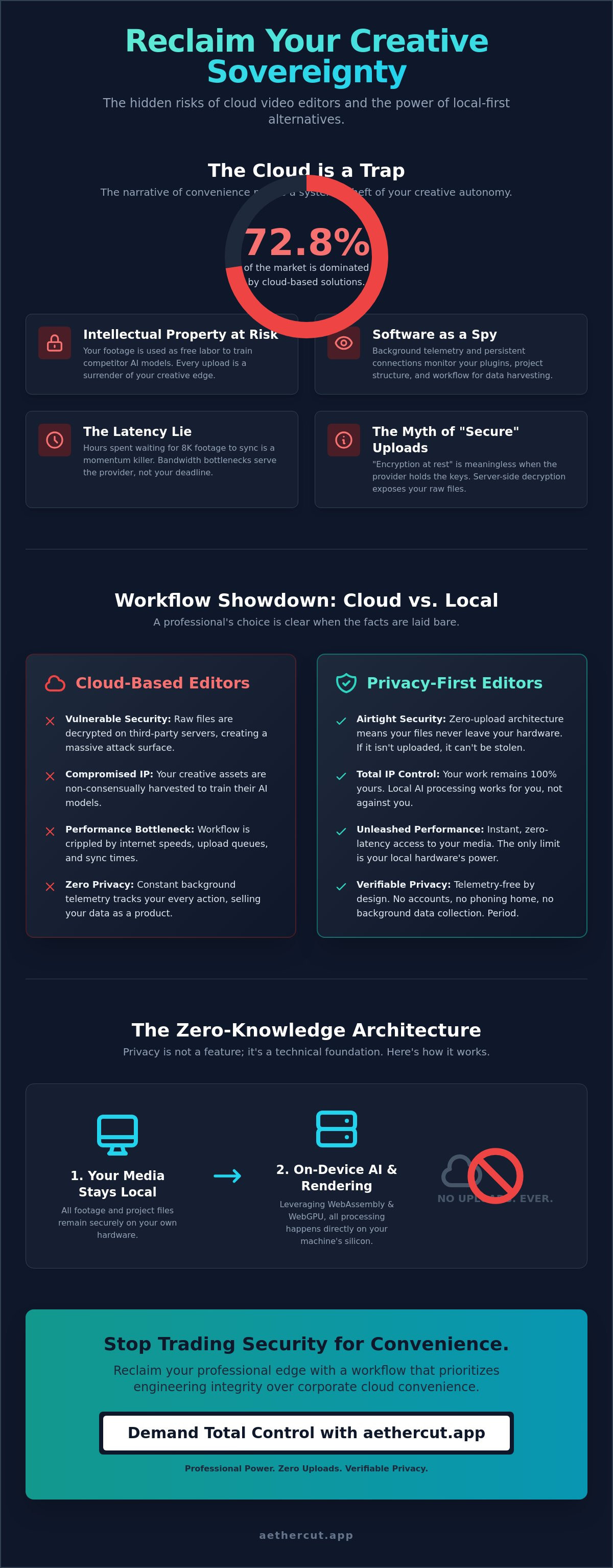
In 2026, cloud-based solutions command 72.8% of the market. This dominance isn't based on superior performance. It's based on data harvesting. Every "free" tier and "seamless" sync comes with a hidden invoice. You pay with your privacy. You pay with your speed. You pay with your intellectual property. A true privacy first video editor rejects this predatory model. It keeps your work where it belongs: on your machine. It prioritizes your right to own your process from the first cut to the final render.
The latency lie is perhaps the most insulting part of the cloud pitch. Moving terabytes of 4K or 8K footage through a consumer pipe is a momentum killer. It's a bottleneck that serves the provider's data collection goals, not the creator's deadline. While you wait for a progress bar, your creative fire dies. Local processing is the only way to maintain professional velocity. Anything else is just a slow leak of your time and your data. We're seeing a definitive shift from "Software as a Service" to "Software as a Spy," where background telemetry monitors your plugins, your project structure, and your workflow efficiency.
The Myth of Secure Cloud Uploads
Don't be fooled by corporate platitudes like "encryption at rest." If the service provider holds the keys, the lock is a mere suggestion. Server-side processing requires your raw files to be decrypted on their hardware to apply effects or AI enhancements. This creates a massive attack surface. Your sensitive media is exposed to rogue employees, third-party contractors, and potential data leaks. Real security isn't a better password. It's a zero-upload architecture. If it never leaves your silicon, it can't be compromised.
AI Training: Your Footage as Free Labor
The industry is witnessing a massive shift. In 2026, 58% of editors use AI features. Most don't realize they're also providing the training data for their future replacements. Mainstream tools use your creative labor to train algorithms that will eventually mimic your unique style. It's non-consensual harvesting on a global scale. A privacy first video editor ensures that AI tools work for you, not against you. Local AI processing means your creative decisions stay private. They stay yours. They stay protected from algorithmic imitation.
What Defines a True Privacy-First Video Editor?
Privacy is not a feature you toggle in a settings menu. It is an architectural commitment. A true privacy first video editor is defined by what it is technically incapable of doing. It cannot see your raw footage. It cannot upload your project files. It cannot track your creative decisions. Most industry giants claim to respect your data while simultaneously phoning home every few minutes to "improve the user experience." That isn't security. That is corporate doublespeak. If the software requires a persistent internet connection to function, it isn't private. It's a surveillance tool with a timeline.
In 2026, the standard for data integrity has shifted. Professionals no longer accept "trust us" as a security protocol. We demand a privacy first video editor that provides verifiable evidence of local processing. This means the software must operate in a telemetry-free environment where no background pings are sent to a central server. Every creative choice, every cut, and every frame remains on your local machine. This level of autonomy is the only way to meet the rigorous standards of the SECURE Data Act 2026. It's time to stop asking for permission to own your work.
Zero-Knowledge Architecture Explained
True creative sovereignty requires a zero-knowledge approach. This is a technical requirement, not a suggestion. It starts with eliminating the server-side middleman. By leveraging modern web technologies like WebAssembly and WebGPU, complex video processing happens directly in your hardware's memory. There is no intermediate cloud stage. This architecture ensures that even the software developers cannot access your media. If you don't need to create an account to start cutting, you've already closed the most common vector for data theft. You can test a zero-upload workflow today and see the difference in both speed and security.
On-Device AI: The New Performance Standard
The myth that AI requires massive cloud server clusters is dead. In 2026, on-device AI is the professional benchmark. Modern GPUs and dedicated NPUs (Neural Processing Units) now handle tasks like "Whisper captions" and generative background removal with near-native performance. This shift addresses the Emerging AI governance considerations that are currently reshaping the creative industry. Local AI processing is faster because it eliminates the bandwidth bottleneck. You aren't waiting for a 10GB file to upload to a remote server just to run a simple mask. You're processing at the speed of your own silicon. This isn't just about privacy. It's about raw, uncompromised power.
Local vs. Cloud: The Performance and Security Trade-off
The cloud is a leash. It promises infinite power but delivers a physical bottleneck. While mainstream marketing claims that remote server clusters are necessary for high-end AI, they ignore the reality of data transfer. Moving a single hour of raw 8K footage can take longer than the edit itself. A privacy first video editor bypasses this physics problem by processing everything on your local silicon. You don't need a server farm when you have a modern GPU. You need software that respects your hardware's potential.
Reliability is the second casualty of the cloud model. If your internet connection drops, your project dies. Professional momentum shouldn't depend on your ISP's uptime. Editing locally means total independence. It means finishing a timeline in a dead zone, on a plane, or in a high-security environment. This isn't just about convenience. It is about verifiable data sovereignty. For journalists and legal teams, the SECURE Data Act 2026 has made local processing a necessity rather than a choice. If you don't control the hardware, you cannot guarantee the protection of your sources.
The security trade-off is equally stark. Every cloud edit creates a digital paper trail. Your project structure, your metadata, and your raw assets are indexed by third parties. In a privacy first video editor, that trail doesn't exist. There are no logs on a remote server. There are no "incidental" data captures. You aren't just avoiding a breach. You're eliminating the target entirely. True security is the absence of a remote database.
Latency and the Creative Flow
Cloud-lag is a rhythm killer. Every time you wait for a preview to buffer or a frame to sync, your creative focus fractures. Professional editing requires instant feedback. You need to feel the cut the moment you hit the spacebar. Local file control provides a psychological edge that no remote server can match. Instant playback. Zero buffering. Total control. When your media stays on your device, the software moves at the speed of your thought, not the speed of your bandwidth.
The Legal Cost of a Data Breach
For healthcare and legal sectors, a data leak isn't just a PR crisis. It is a legal catastrophe. NDAs often explicitly forbid third-party cloud processing for sensitive evidence or patient recordings. Using a cloud-based editor in these environments is a breach of contract waiting to happen. Local editing is the only way to satisfy the "Delete Act" requirements under the updated CPRA in 2026. It ensures that when you delete a file, it is actually gone. No shadow copies. No server backups. Just absolute compliance through technical isolation.
Securing Your Edit Suite: A Professional Checklist
Trust is a liability. In an industry where corporate surveillance is the default, you must treat your software like a potential informant. A true privacy first video editor doesn't ask for your confidence; it invites your inspection. If you cannot verify the data flow, you do not own the suite. Securing your creative environment requires a shift from passive consumption to active auditing. It is time to move beyond the "install and ignore" mindset. Your intellectual property depends on it.
The transition to a secure workflow begins with radical transparency. You need to know exactly what happens when you hit the export button. Does your software ping a remote server? Does it "check for updates" while your timeline is open? These are often covers for telemetry harvesting. You can verify your security by using network monitoring tools to track every packet leaving your machine. If the software is truly private, the traffic should be zero. Stop asking for permission. Start auditing. You can deploy a verifiable privacy first video editor to reclaim your workstation today.
Software Auditing for Creators
Most popular editors are black boxes. They hide "phone home" behavior behind complex EULAs. To secure your suite, use tools like Little Snitch or Wireshark to identify unauthorized background transmissions. Look for persistent connections to cloud-storage domains or AI-training endpoints. If your editor requires an "always-on" connection for AI tasks, it is a data leak in waiting. Choose standards that prioritize local execution over proprietary cloud dependencies. If the code isn't transparent, the security isn't real.
Hardware Optimization for 2026
Professional local editing in 2026 demands more than generic CPU power. You need a workstation built for the era of on-device intelligence. Prioritize hardware with dedicated AI accelerators or NPUs (Neural Processing Units). These chips are designed to handle "Whisper captions" and generative fills without taxing your primary processor. For 8K workflows, 128GB of high-speed RAM and at least 24GB of VRAM are the new benchmarks. Your storage should also be physically secured. High-speed NVMe drives with hardware-level encryption ensure that even if your machine is stolen, your raw footage remains inaccessible. Speed is useless without sovereignty.
Network isolation is the final step for high-stakes projects. For journalists or legal teams, editing in an air-gapped environment is the only way to guarantee source protection. A privacy first video editor must function perfectly without an internet connection. No login screens. No license pings. No cloud-based "assistance." If your software breaks when you pull the plug, it was never yours to begin with. Control the hardware, isolate the network, and secure the edit.
AetherCut: Professional Power. Zero Uploads. Total Control.
The status quo is a choice. You can continue to feed the cloud machine, or you can reclaim your creative autonomy. AetherCut is the definitive privacy first video editor designed for those who refuse to compromise. It is a tool built on a foundation of radical transparency and engineering integrity. We don't ask for your trust. We provide the technical evidence of your security. In an era of data harvesting, AetherCut stands as a defiant alternative to the industry's surveillance-heavy standards.
AetherCut Zero Uploads isn't a marketing slogan. It is a hard technical boundary. Your media never leaves your device. Your project files never touch a remote server. Your creative decisions remain your own. By leveraging the power of your local silicon, AetherCut delivers professional-grade performance without the vulnerability of the cloud. This is the new standard for creative sovereignty. It is fast. It is secure. It is verifiable.
Professional power no longer requires a data trade-off. AetherCut provides up to 72 professional tools, including 30 AI-assisted features that run entirely on your local hardware. Whether you're using "Whisper captions" or advanced background removal, the processing happens on your machine. We've eliminated the bandwidth bottleneck. We've removed the privacy risk. You get the efficiency of modern AI with the security of an air-gapped suite. This is how professional editing should function in 2026.
The AetherCut Difference: Verifiable Integrity
Integrity is found in the code, not the copy. AetherCut proves its privacy through a zero-upload architecture that you can monitor yourself. By utilizing WebAssembly and WebGPU, we bring near-native performance directly to your browser or PWA. This isn't just about avoiding leaks. It's about data sovereignty. We've even adopted the "llms.txt" standard to ensure total transparency in how information about our product is shared. We prioritize technical truth over corporate platitudes. Your work stays on your hardware because that is the only place it is truly safe.
Getting Started with Secure Editing
Transitioning to a secure workflow is a decisive act. You can start cutting with AetherCut in three immediate steps. First, launch the application as a PWA for total offline capability. Second, import your 4K or 8K footage directly from your local drive. Third, execute your edit using our suite of local AI tools. There is no account to create. There is no cloud sync to wait for. You can access our Core tier for free or upgrade to the Pro tier for 4K exports and unlimited projects. Join the manifesto for a more honest creative industry. Reclaim your edge. Own your edit.
Reclaim Your Creative Autonomy
The era of cloud dependence is over. You've seen the risks. You've felt the delays. You've faced the exposure. Real sovereignty isn't a setting; it's an architectural fact. True creative freedom requires a privacy first video editor that operates entirely on your local hardware. You shouldn't have to choose between cutting-edge AI and absolute data security. It's time to demand tools that work for you, not for a data broker's training set.
AetherCut exists to end that compromise. Our zero-upload architecture is verified by third-party audits. Your media never leaves your device. We provide on-device AI optimized for 2026 hardware. This delivers speed. This delivers power. This delivers peace of mind. It's why leading investigative journalists and secure enterprises have already made the switch. Your work is your capital. Your style is your edge. Protect them both with software that respects your rights.
Stop asking for permission to own your process. Take control of your suite and your future. Download AetherCut: The Only Verifiable Privacy-First Professional Editor. The industry is changing. Be the one who leads it.
Frequently Asked Questions
What is a privacy-first video editor?
A privacy first video editor is defined by its architecture, not its marketing. It is software where data sovereignty is the core requirement. Your media never leaves your local silicon. There are no mandatory cloud syncs. No hidden background uploads. It ensures that you maintain absolute ownership of your intellectual property by keeping the entire creative process on your own hardware.
Does a zero-upload video editor mean I can’t use AI features?
No. On-device AI has replaced the need for massive server clusters. AetherCut runs sophisticated models directly on your GPU or NPU. You can generate "Whisper captions" or perform complex background removals without sending a single byte to the internet. You get professional intelligence without the privacy trade-off. It's efficiency without the surveillance.
How do I verify if my video editor is actually private?
Don't take a developer's word for it. Monitor your network traffic during an edit session. Use professional tools like Wireshark or Little Snitch to track every packet leaving your machine. A legitimate privacy first video editor will show zero outgoing data to third-party servers. If the software demands a persistent connection to function, it isn't private. It's a tracking tool.
Is local AI editing slower than cloud-based AI?
Local processing is often faster because it eliminates the bandwidth bottleneck. Cloud AI requires you to wait for massive 4K or 8K file uploads before processing even begins. Local AI starts the moment you hit the command. By leveraging your workstation's raw power, you bypass the latency of remote servers. You move at the speed of your hardware, not your ISP.
Why should journalists and legal professionals avoid cloud editors?
Cloud editors are a liability for source protection. Every upload creates a digital paper trail on a third-party server. For investigative journalists or legal teams, this exposure can violate NDAs or the SECURE Data Act 2026. Local processing is the only way to guarantee that sensitive evidence or confidential interviews remain truly isolated from corporate or government surveillance.
Can I use AetherCut without an internet connection?
Yes. AetherCut is built for total independence. Once you install it as a Progressive Web App (PWA), it functions perfectly in air-gapped environments. There are no forced login screens. No license pings. No cloud dependencies. It is designed for high-stakes projects where a connection is either impossible or a security risk. You own the software; you control the connection.
What hardware do I need for a privacy-first AI video editor?
Performance requires professional-grade silicon. Prioritize workstations with dedicated AI accelerators and high VRAM. For 8K workflows, we recommend at least 128GB of RAM and a GPU with 24GB of VRAM. This ensures your local machine handles generative tasks with the same velocity as a server farm. High-speed NVMe storage is also essential for maintaining 2026 performance standards.
Does AetherCut collect any telemetry or usage data?
Zero. We don't track your cuts. We don't index your metadata. We don't monitor your creative decisions. AetherCut is a telemetry-free environment. We prioritize technical truth and engineering integrity over data harvesting. Our code is built to be verifiable, ensuring that your workstation remains a private sanctuary for your work. If we can't see it, we can't leak it.