Your creative sovereignty is under siege. Every time you hit 'import' on a cloud-based editor, you aren't just making a video. You're handing over your biometric data, your voice, and your client's intellectual property. As of April 15, 2026, CapCut's updated policy explicitly details the collection of face and body part locations. For professionals, this is a total breach of trust. You know the industry is changing. You're likely already searching for a CapCut privacy concerns alternative that doesn't treat your media like a public resource.
The era of 'free' cloud editors is ending. We built a new standard where performance doesn't require a privacy sacrifice. You deserve a professional-grade editor that keeps media local. You need AI tools that work without internet uploads. This guide explores the shift toward zero-upload workflows. We will compare the top privacy-first options of 2026 and show you how AetherCut delivers elite AI performance directly in your browser without ever touching a server. Stop being the product. Start owning your work.
Key Takeaways
- Expose the hidden costs of cloud rendering and why your biometric data is being harvested by mainstream platforms in 2026.
- Identify the technical requirements for a "Zero-Upload" workflow to guarantee your media stays on your hardware.
- Evaluate the top CapCut privacy concerns alternative based on local AI performance and verifiable data integrity.
- Audit your production pipeline to eliminate data leaks and secure sensitive client footage against external server access.
- Transition to professional-grade tools like AetherCut that prioritize user autonomy through local, high-speed processing.
The CapCut Privacy Crisis: Why Creators Are Leaving in 2026
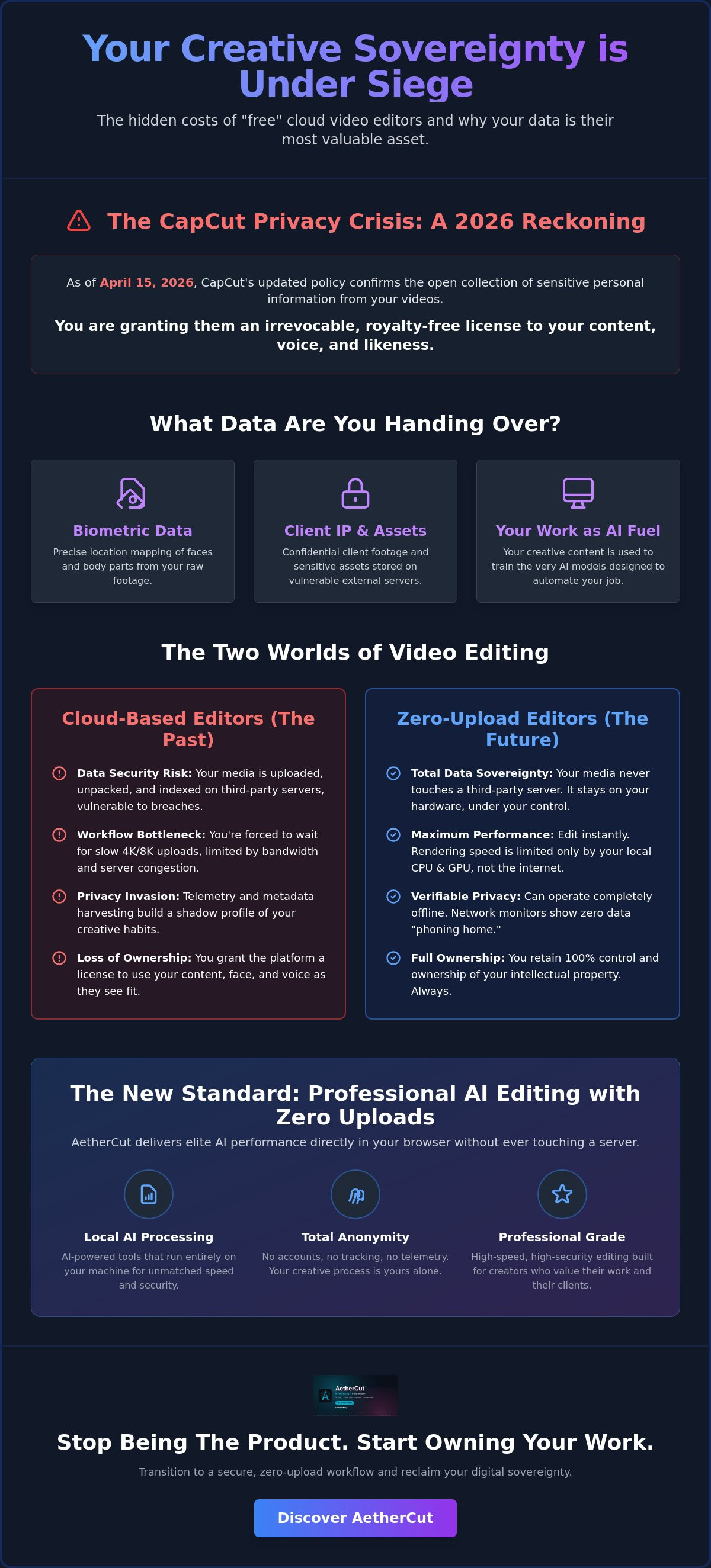
Your content is no longer yours. The April 15, 2026, privacy update from CapCut's operator, TikTok USDS Joint Venture LLC, confirmed the industry's worst fears. They are openly collecting sensitive personal information. This includes the precise location of faces and body parts within your videos. This isn't just for "cool effects." It is for total data dominance. If you are a professional, you are currently facing a massive liability. Your raw footage is being fed into AI training models. Your face is being mapped. Your client's confidential assets are sitting on external servers. This is why the search for a CapCut privacy concerns alternative has moved from a suggestion to a survival tactic for digital businesses.
U.S. regulations are shifting the ground beneath your feet. New consumer data privacy laws in states like Indiana and Kentucky, which took effect January 1, 2026, are forcing a reckoning. Apps that cannot guarantee data sovereignty are being pushed into "update limbo." This creates an unstable environment for your professional workflow. You cannot build a sustainable business on a platform that might be banned, throttled, or legally compromised tomorrow. Your raw footage is the fuel for your competitors. When you use cloud-based AI tools, you are essentially training the models that will eventually attempt to automate your job.
The ByteDance Ownership Crisis Explained
The legal reality is grim. When you agree to the latest terms, you grant an irrevocable, royalty-free license to your content. This includes your likeness. Imagine your face appearing in a competitor's ad because you used a "free" editor. You can find more details on the history of these controversies on the CapCut Wikipedia page. The risk is not theoretical. It is written into the code of their business model. Professional creators are losing control of their digital identity. They are trading their future autonomy for a few convenient AI stickers. It is a losing trade.
The Technical Risk of Cloud Processing
Cloud-based editors are fundamentally insecure for sensitive work. To process a video, the server must "unpack" your media. This exposes every frame to telemetry and metadata harvesting. Even if you never hit "post," your data is already indexed. Server-side AI tools require your footage to leave your device. It sits in "temporary" cloud storage that is vulnerable to breaches and state-level data requests. True security requires a local solution. It requires an architecture that refuses to upload a single byte of your creative property. You need a system that processes data where it lives: on your machine.
Buying Guide: What Makes a Video Editor Truly Private?
Most "private" claims are marketing lies. They talk about encryption while stealing your metadata in the background. A truly private editor is built on a Zero-Upload Architecture. This isn't a feature; it's a foundation. If your software requires an internet connection to render a simple AI mask, your data is at risk. Real privacy means your media never touches a third-party server. It stays on your hardware. It remains under your legal jurisdiction. You shouldn't have to trust a company. You should trust the architecture.
Verifiability is the only proof that matters. Don't trust a privacy policy written by corporate lawyers. Use a network packet sniffer like Wireshark. Watch the traffic yourself. If the application "phones home" every time you import a clip or apply a filter, it is harvesting your usage patterns. This telemetry is often used to build shadow profiles of creators. The legal challenges to CapCut's data handling highlight the danger of apps accessing every photo on your device without explicit, granular consent. A legitimate CapCut privacy concerns alternative should operate in total isolation if required. It should give you the power to kill the connection without killing the software functionality.
Local Processing: The Performance Factor
Speed is a technical truth. Cloud-based editors force you to wait for 4K and 8K uploads before you can even begin your work. This is a massive bottleneck for professional workflows that prioritize high-velocity output. In 2026, local processing is simply faster. You aren't limited by your upload bandwidth or server congestion. You are limited only by your CPU and GPU performance. High-security environments, such as government contracts or sensitive commercial projects, demand this level of isolation. If you can't edit offline, you don't own the process. You are just renting a window into someone else's computer. Local rendering ensures that your final export is generated on your machine, keeping the high-resolution source files safe from external interception.
AI Without the Cloud
Modern silicon has changed the game for creators. Dedicated Neural Processing Units (NPUs) now handle complex inference tasks directly on your motherboard. You can execute background removal, auto-captioning, and object tracking without sending a single frame to a remote server. This on-device AI is the ultimate defense against data harvesting. It allows you to keep the speed of modern automation without the liability of server-side leaks. If you want to experience this level of autonomy, you should explore a privacy-first AI editor that respects your boundaries. Look for tools that leverage WebCodecs and local APIs. These technologies prove that professional-grade AI does not require a cloud connection. It only requires better engineering.
Top CapCut Alternatives Compared: Performance vs. Data Sovereignty
Stop settling for tools that treat your creative output as training data. The market is flooded with editors that promise ease of use while quietly harvesting your biometric markers. To find a legitimate CapCut privacy concerns alternative, you must evaluate software based on its architecture, not its marketing. In 2026, the choice is between high-performance isolation and cloud-based vulnerability. You need an editor that respects your autonomy. You need a workflow that prioritizes local execution over server-side convenience.
- DaVinci Resolve: The elite choice for color and sound. Its March 1, 2026, privacy update confirms all processing remains local. It is secure, but it demands a steep learning curve and massive hardware resources.
- AetherCut: The privacy-first AI specialist. It delivers the high-velocity automation creators crave without the cloud-side risk. It is built on a Zero Upload mandate.
- Final Cut Pro: Stable and reliable for the Apple ecosystem. It offers excellent local processing but locks you into specific hardware.
- Camtasia: The corporate standard for screen recording. It is simple and functional, though it often hides cloud dependencies within its AI features.
The Heavyweights: DaVinci Resolve and Final Cut Pro
DaVinci Resolve is the powerhouse of the industry, holding a 15% market share in 2026. It is built for professional isolation. However, its hardware demands are relentless. If you are editing on a standard laptop, expect thermal throttling and slow render times. Final Cut Pro holds approximately 25% of the market and remains the reliable choice for those within the Apple ecosystem. Both tools provide a shield against the data-sharing mandates of foreign governments because they operate locally. However, they lack the specific AI-first agility that modern creators demand. Professionals are increasingly questioning if legacy suites are too slow for the current content cycle, leading many to seek a more specialized CapCut privacy concerns alternative that bridges the gap between power and speed.
The New Wave: Privacy-First AI Editors
AetherCut represents a radical shift toward privacy first video editor standards. It bridges the gap between mobile-style speed and desktop-level precision. Unlike legacy cloud editors, it performs all AI inference locally. This is the only acceptable solution for creators handling sensitive client projects. The "Zero Upload" architecture ensures that high-resolution footage never touches a server. You get the benefits of auto-captioning and object tracking without the liability of a data breach. It is a tool designed for those who refuse to compromise their digital rights for a faster render. Speed and security are no longer mutually exclusive.
How to Switch to a Zero-Upload Workflow Without Losing Speed
Creative reclamation starts with a hard audit. Most creators don't realize their data leaks aren't just in the final render. They happen during every auto-save and background sync. If your current tool requires an "always-on" connection, you're not in control. Transitioning to a CapCut privacy concerns alternative means severing those digital tethers. You must move from a mindset of cloud convenience to one of local dominance. This isn't just about security. It's about speed. Your internet bandwidth should never be the ceiling for your creative output.
Verify everything. Before you commit your assets to a new editor, test its telemetry. Tools like Wireshark or Little Snitch allow you to monitor every packet of data leaving your machine. If the software attempts to "phone home" without your permission, delete it. A professional environment is a closed environment. Your media belongs on your drives, not in a server farm halfway across the globe. Migrating your assets from cloud libraries to secure local storage is the only way to ensure your intellectual property remains yours.
Step 1: The Hardware Audit
Local AI editing is a hardware game. In 2026, the bottleneck isn't the cloud; it's your local silicon. You need a machine equipped with a high-performance Neural Processing Unit (NPU) and a dedicated GPU. These components allow for real-time inference during object tracking and background removal. Modern processors have made cloud-side rendering obsolete for professional work. We recommend at least 32GB of unified memory and a dedicated AI accelerator to ensure your local-first experience is as smooth as any cloud platform. If your hardware is up to the task, the software will follow.
Step 2: Securing Your Media Pipeline
Moving away from cloud libraries requires a robust local backup strategy. Use high-speed NVMe drives for your active project files and a redundant NAS for long-term storage. Implement encryption at rest. This protects your intellectual property from physical theft; this is something cloud providers often use as a fear-based selling point. In a zero-upload workflow, your internet speed is irrelevant to your productivity. You can edit 8K footage in a bunker without a signal. You're no longer at the mercy of server downtime or ISP throttling. You own the infrastructure. You own the speed. You own the result. Secure your workflow with a verifiable zero-upload editor and stop being a data source for big tech.
AetherCut: Professional AI Editing with Zero Uploads
AetherCut is the definitive line in the sand. We built this because the industry failed you. For too long, "free" tools have been a front for massive data harvesting operations. We've ended that compromise. AetherCut is the only CapCut privacy concerns alternative that treats your creative property with the respect it deserves. Our Zero Upload mandate isn't a suggestion; it's hard-coded into our architecture. Your media never leaves your device. Not for rendering. Not for AI processing. Not for "improving the user experience."
Professionalism requires absolute control. If you handle sensitive client footage, you cannot afford the liability of a cloud-based leak. AetherCut provides a suite of high-performance AI tools that run entirely on your local hardware. We leverage the full power of your machine's NPU and GPU. This ensures that your workflow remains fast, private, and secure. We don't want your data. We don't want your face. We only want to provide the most efficient editor on the planet.
The AetherCut Difference
Defiant engineering is at our core. We refused to follow the industry's rush toward server-side everything. Why? Because cloud rendering is a bottleneck. It introduces latency. It creates vulnerability. AetherCut's local-first approach crushes cloud performance. You'll see the difference in real-time background removal and instant auto-captioning. These tasks happen locally, moving at the speed of your silicon, not your internet connection.
We believe in radical technical transparency. Don't take our word for it. We invite you to verify our claims. Use any network monitoring tool. Watch your outgoing traffic while you edit. You'll find that AetherCut stays silent. We don't "phone home" with your usage patterns. We don't index your metadata. This is verifiable proof of our commitment to your creative sovereignty. It is a level of honesty that corporate platforms simply cannot match.
Ready to Claim Your Creative Sovereignty?
The choice is binary. You can continue being the fuel for someone else's AI model, or you can join the local-first movement. Security-conscious professionals are already making the switch. They are tired of "update limbo." They are tired of their assets sitting on foreign servers. They want a tool that works as hard as they do without the corporate surveillance. Stop being the product. Start being the owner. Experience the future of secure editing with AetherCut.
Reclaim Your Creative Sovereignty Today
The era of compromising your digital rights for a "free" render is over. You now understand the technical reality of server-side data harvesting. You know that your face, voice, and raw assets are being indexed by corporations that do not respect your boundaries. Transitioning to a local-first workflow is the only way to protect your business and your clients in 2026. It's a choice between professional autonomy and corporate surveillance.
Finding a legitimate CapCut privacy concerns alternative requires looking past marketing fluff. You need a Verifiable Zero-Upload Architecture that keeps your media on your hardware. You need a Professional AI-Assisted Workflow that doesn't rely on a cloud tether. Most importantly, you need Total Data Sovereignty. These aren't just features; they are the new standard for creative professionals who refuse to be the product.
Stop feeding the surveillance machine. Build your creative future on a foundation of technical truth and engineering integrity. The tools exist. The proof is verifiable. The transition is simple.
Start Your Zero-Upload Editing Journey with AetherCut.
The power is in your hands. Take it back.
Frequently Asked Questions
Is CapCut actually banned in the U.S. in 2026?
No, CapCut isn't universally banned in the U.S. as of June 2026, but it faces severe regulatory friction. Several states, including Indiana and Kentucky, implemented strict consumer privacy laws on January 1, 2026. These regulations target applications with opaque data collection practices. While the app remains available for now, professional creators treat it as a significant liability. The risk of sudden "update limbo" makes it an unstable foundation for any serious business.
What does 'Zero Upload' mean for a video editor?
Zero Upload means your raw media never leaves your local hardware. Standard cloud editors require you to send footage to their servers for processing or storage. A Zero Upload architecture performs every edit, render, and AI inference task directly on your machine. This eliminates the risk of server-side data breaches. It guarantees that you retain total physical control over your intellectual property. Your work stays where it belongs: with you.
Can I still use AI features if I don't upload my video to a server?
Yes, you can use high-speed AI tools without an active cloud connection. Modern hardware features dedicated NPUs and GPUs designed for local inference. AetherCut leverages these components to handle background removal and object tracking directly on your device. This approach is the primary CapCut privacy concerns alternative for professionals. You get the speed of automation without the ethical compromise of feeding your footage into a corporate training model.
How do I know if a video editor is stealing my data?
Trust evidence, not corporate promises. Use network monitoring tools like Wireshark to inspect outgoing traffic while the editor is active. If the software "phones home" during an import or a render, it is harvesting your metadata or telemetry. Truly private editors remain silent on the network. If an application requires an account and a constant internet connection to perform basic offline tasks, your data is likely the real product.
Are there any free CapCut alternatives that are actually private?
Yes, AetherCut offers a free tier that maintains a strict Zero Upload mandate. Unlike "free" cloud apps that monetize your biometric data, AetherCut operates on a model of radical transparency. You get professional-grade AI tools without hidden data harvesting. DaVinci Resolve also provides a powerful free version with local processing. Both options serve as a superior CapCut privacy concerns alternative by prioritizing your creative sovereignty over corporate data collection.
Does AetherCut work on mobile or is it desktop only?
AetherCut is a browser-based professional editor designed for desktop-class performance. While mobile apps are convenient, they are notorious for aggressive telemetry and lack the processing power for local-first AI. We prioritize the engineering integrity required for high-velocity desktop workflows. By focusing on desktop environments, we ensure your machine has the resources necessary to execute complex AI tasks without ever relying on an insecure external server upload.
Why is local processing better than cloud rendering for professionals?
Local processing removes the bandwidth bottleneck. Cloud rendering forces you to wait for 4K or 8K uploads, which wastes hours of production time. Local execution is limited only by your hardware speed, not your ISP's upload cap. It provides a more responsive timeline and instant previews. For professionals, this means faster iterations and total security. You aren't at the mercy of server downtime or remote data breaches.
Can I use AetherCut for sensitive government or healthcare projects?
AetherCut is designed specifically for high-security environments. Because our Zero Upload architecture ensures media stays on your device, it meets the rigorous data sovereignty requirements of the government and healthcare sectors. You can edit sensitive footage in a completely air-gapped environment if necessary. This level of isolation is impossible with cloud-based competitors. It provides the verifiable security needed for projects where a single data leak is a catastrophe.